Early Nutrition Changes in Aging Family Members: Common Deficiencies and Subtle Signs
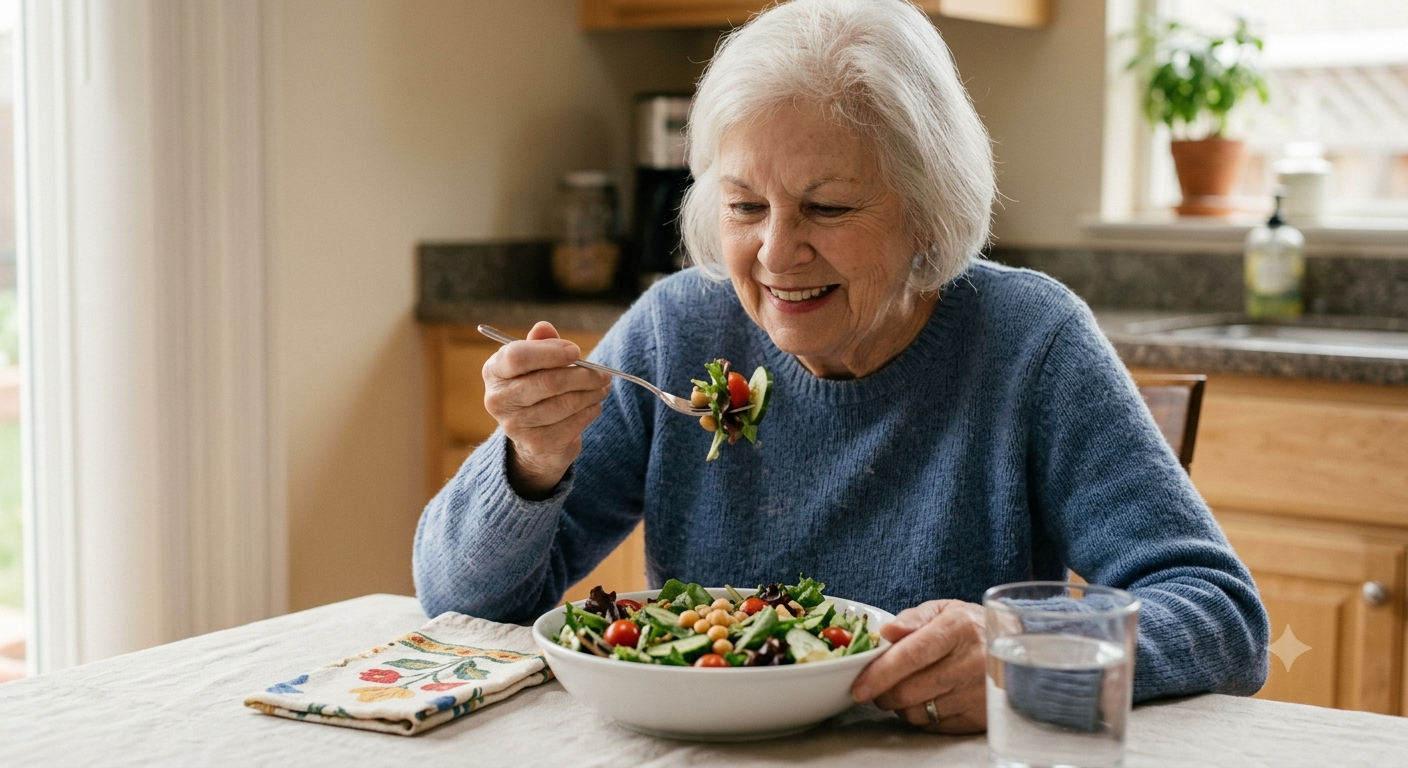
This is a critical window for nutrition. A national community-based sample of US older adults found 26% at nutritional risk and another 6% already malnourished, with risk notably higher among those living alone. Malnutrition disrupts cognitive function, promotes muscle and bone loss, and increases mortality, and in a NHANES-based study of US older adults, malnutrition was associated with meaningfully higher odds of cognitive impairment after adjusting for other factors. The two conditions also feed each other: malnutrition can damage brain function and accelerate cognitive decline, while cognitive decline itself leads to changes in eating behavior that increase the risk of malnutrition.
That makes the in-between period, when someone is still independent but beginning to struggle, the highest-leverage point for intervention. Here's what to look for and what to actually do about it.
Tea and Toast Syndrome
The term describes an older adult who used to cook real meals shifting to tea, toast, crackers, maybe a can of soup. Cooking is a multi-step task that draws on planning, sequencing, and memory, and those abilities often decline before appetite itself drops, and often before any weight loss becomes visible. By the time you notice someone has lost weight, the shortfall has usually been building for months.
Common Deficiencies to Have on Your Radar
B12. Absorption naturally declines with age-related drops in stomach acid, and several common medications make it worse. Deficiency can mimic or worsen cognitive symptoms.
Protein, especially how it's distributed across the day (numbers below).
Vitamin D, given limited sun exposure and reduced dietary variety.
Thiamine. Reduced overall food intake and variety, the tea-and-toast pattern, reduces thiamine intake along with most micronutrients. Alcohol use is the more significant driver of clinically relevant deficiency in this population.
Zinc. Deficiency contributes to reduced taste acuity, slower wound healing, and impaired immune function, and intake tends to drop with reduced meat consumption, since zinc from plant sources is less bioavailable.
Omega-3s. Dietary intake tends to be low in this population, and omega-3 PUFAs help modulate inflammation and support brain, cardiovascular, and immune function in older adults, with evidence suggesting a meaningful role in reducing cognitive decline risk.
Subtle Signs of Nutritional Risk
Expired food piling up in the fridge, often because of reduced consumption or because grocery planning and timing have gotten harder
Clothes that fit looser, mistaken for "they've always dressed that way"
New trouble opening jars or other tasks that require grip strength.
Avoiding grocery trips
Eating the same thing daily, which can reflect difficulty planning varied meals
Less interest in food generally, sometimes tied to depression or unreported changes in smell or taste
Physical Changes to Watch
These matter most when they're new or clearly increasing, not just present:
Newly pushing off with their arms to get out of a chair, when they used to just stand
New reliance on walls or furniture in a space they've lived in for years
A walk that's gotten noticeably shorter or slower from kitchen to table
Increasing breathlessness walking to the mailbox or taking out the trash
Dropping things more often
New trouble with jars, doorknobs, can openers
New reliance on a cane or walker
Observations You Can Make in Conversation at Your Next Visit
Increasing hollowness at the temples or visible muscle loss at the shoulders or calves
Hands: flattening of the webbing between thumb and index finger (a fairly specific sign of muscle loss), ridged or spoon-shaped nails
Mouth: cracking at the corners, a tongue that looks unusually smooth or red
Eyes: pale lower eyelid lining
Fit: rings spinning loosely, a watch needing a new hole, clothes fitting loosely.
Worth noting: easy bruising and slower wound healing do become somewhat more common with age on their own, due to thinner skin and reduced collagen, so these aren't reliable flags by themselves. They're more meaningful paired with other findings here, or if they represent a clear change from how this person normally presents.
If any of these are new or sudden, regard it as a possible flag for newer-onset malnutrition. If they've been present for a while, it may be an expected part of aging or it could point to a longer-standing deficiency that's already taken hold, which could be addressed with the help of a nutritionist.
Appetite: Why It Disappears and What Brings It Back
Contributors to declining appetite:
Depression suppresses appetite directly, and isolation (loss of a spouse, friends, driving privileges) is common at this stage and easy to miss from a distance
Less activity often means less genuine hunger signaling
Less movement also slows digestion, adding bloating and early fullness
Eating alone removes the social cues that normally drive intake
Smell and taste changes blunt food's reward value, compounding with depression-related loss of interest generally
What helps:
Eating together, even by phone or video during the meal itself
A short walk before a meal to stimulate genuine hunger
Smaller, more frequent eating opportunities instead of three large meals
Bold herbs and aromatics, especially when smell has declined
Familiar, nostalgic dishes, which often get eaten when "healthy" suggestions don't
A dental check: since tooth or gum pain or poorly fitting dentures are underappreciated contributors to decreased dietary intake and variety.
Protein: The Actual Numbers
Healthy older adults generally need 1.0 to 1.2 g/kg of body weight per day, higher than the standard adult recommendation, climbing to roughly 1.2 to 1.5 g/kg for anyone managing illness, recovering from a hospital stay, or already showing signs of muscle loss. For a 150-pound person, that's about 70 to 100+ grams a day.
Higher-protein sources to keep on hand:
Canned salmon, tuna, or sardines, no prep required
Greek yogurt, soft texture if chewing or swallowing is an issue
Cottage cheese
Eggs, hard-boiled ahead for grab-and-go
Home-poached or baked chicken breast, batch-cooked and portioned; a lower-sodium alternative to store rotisserie chicken, which is often brined or heavily seasoned
Canned beans or lentils for a no-cook plant option
On protein shakes: they're a reasonable backup, not a replacement for real food. Look for products with minimal added sugar, a recognizable, short ingredient list, and a meaningful protein-to-calorie ratio, at least 20g of protein in roughly 150-200 calories, so protein is providing close to half the total calories rather than sugar or fillers. Worth avoiding: products marketed similarly that carry 15g or more of added sugar per serving, since sugar content varies widely even within the same category.
Fortifying What They Already Eat
Often the easiest entry point isn't a new food, it's a small upgrade to something already in the rotation:
Regular yogurt swapped for Greek yogurt, roughly double the protein for the same serving
Canned salmon, tuna, or sardines added to the crackers they're already eating
Unflavored whey protein stirred into oatmeal, soups, casseroles, or mashed potatoes, an easy way to boost protein without changing taste much; best added to moist dishes rather than baked goods, where it can dry out the texture
An egg or canned chicken added to a bowl of soup near the end of cooking
Nut butter spread on toast or fruit instead of butter or jam alone
A spoonful of ground flax or chia stirred into oatmeal or yogurt for fiber and omega-3s
Kitchen Safety: Matching the Task to the Ability
Cooking can become a genuine safety issue: a stove left on, a forgotten step mid-task, a cast iron pan that's suddenly hard to lift. Whether the right response is simplifying recipes or shifting to mostly ready-made meals depends a lot on how much independence is realistically still safe.
For someone still managing well but slowing down: simplify recipes rather than replace them. One-pot, oven-based meals with fewer steps reduce the number of moments something can be forgotten on a lit burner.
Pre-prepped components (washed produce, pre-chopped vegetables, marinated proteins) cut down on knife work and active stovetop time while preserving real cooking.
For someone with more noticeable safety lapses: microwave-ready meals remove the stovetop risk entirely.
Visual and safety upgrades help regardless of stage: large-print dial markings, induction cooktops that stay cool to the touch, and a loud timer paired with any burner use.
Having a home aide come in to assist with meal prep and cook for (or with!) your family member is a gentle way to introduce the idea of assistance within the home.
A Brief Note on Meal Delivery
It's not in everyone's budget, and grocery delivery paired with the strategies above is often the more affordable route. If delivery is on the table, look specifically for sodium content and avoid auto-renewing subscriptions, which can create their own confusion for someone with early cognitive changes. Mom's Meals is sometimes partially covered by Medicaid for those who qualify, which is worth checking before ruling it out on cost alone.
What Now?
Sometimes optimizing nutrition in an aging family member calls for a small adjustment: a grocery delivery set up together, a higher protein breakfast that doesn't require cooking, a recipe simplified to one pan, or swapping in a more nutrient-dense version of a food they already like. Other times, what you're seeing may warrant a full nutrition assessment, a conversation with their physician, or structural changes to their daily support.
© 2026 Ellie Whitenack, MS, Integrative Nutrition, LLC. All rights reserved.
This content is for educational purposes only and is not intended to diagnose, treat, or replace medical care.
Sources:
Bauer, J., Biolo, G., Cederholm, T., Cesari, M., Cruz-Jentoft, A. J., Morley, J. E., Phillips, S., Sieber, C., Stehle, P., Teta, D., Visvanathan, R., Volpi, E., & Boirie, Y. (2013). Evidence-based recommendations for optimal dietary protein intake in older people: a position paper from the PROT-AGE Study Group. Journal of the American Medical Directors Association, 14(8), 542–559. https://doi.org/10.1016/j.jamda.2013.05.021
DiMaria-Ghalili, R. A., Granche, J., Coates, M., Hathaway, Z., & Sefcik, J. (2020). Prevalence of Malnutrition in a National Sample of Older Adults Residing in Community or Residential Care: NHATS 2017. Innovation in Aging, 4(Suppl 1), 793. https://doi.org/10.1093/geroni/igaa057.2874
Molfino, A., Gioia, G., Rossi Fanelli, F., & Muscaritoli, M. (2014). The role for dietary omega-3 fatty acids supplementation in older adults. Nutrients, 6(10), 4058–4073. https://doi.org/10.3390/nu6104058
Zhang, X., Yang, L., Wang, Z., Wang, H., Nie, S., Zhao, C., Kang, S., Zhang, C., & Pan, C. (2025). Associations between nutritional status and cognitive impairment in older adults: results from the NHANES 2011-2014 cycles. Frontiers in nutrition, 12, 1571990. https://doi.org/10.3389/fnut.2025.1571990